
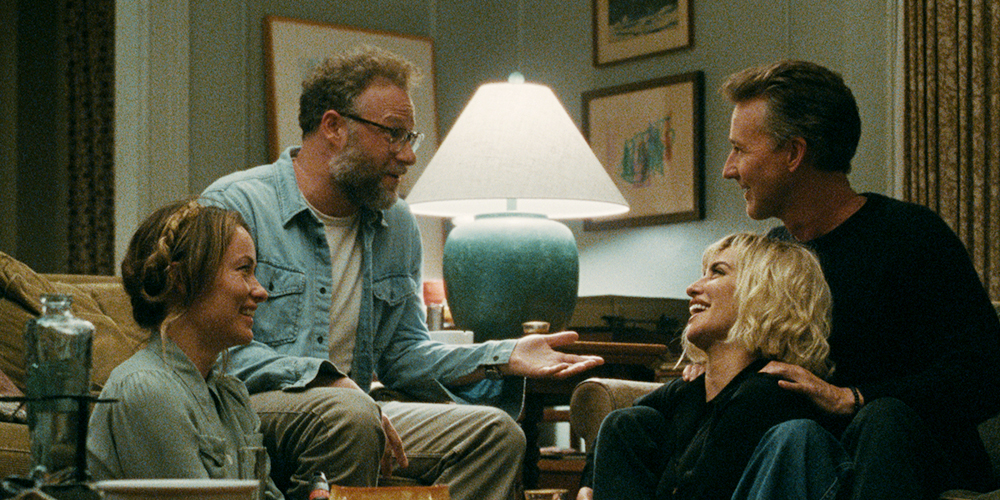
An Oscar Wilde quote setting apart love and marriage opens The Invite, A24’s hilarious dark comedy about relationships. Directed by Olivia Wilde (no relationship other than admiration), the movie is a remake of Cesc Gay’s Spanish film Sentimental. The story wastes no time demonstrating the love/marriage distinction. Seth Rogen and Olivia Wilde play Joe and Angela, a San Francisco couple whose interactions are sniping and dismissive. Why did Angela buy him a bike, Joe moans as he rests on the floor. Angela, it’s clear, is managing the house and managing Joe. Angela reminds him she’s invited over the couple from upstairs, Hawk (Edward Norton) and Piña (Penélope Cruz). Joe says he wasn’t aware. They start to argue and then there’s a knock at the door. In walk the stylish and supremely confident Hawk and Piña. What plays out is like Who’s Afraid of Virginia Woolf?, if the visiting couple were not only happier, but more secure, than their hosts.
The movie’s marketing has done an admirable job of leaving plot and story unclear. Knowing little as a viewer is good, given that most of the character turns are surprises. Like Virginia Woolf, this is a four-person ensemble piece and it allows time for character dynamics in every direction. At the start, Joe stays aloof, Angela eager to impress. Hawk and Piña remain cool—they’re positive but a bit formal. Wardrobe distinguishes the couples as well, with Joe and Angela in plainer tones, Hawk and Piña in dark shirts and denim. As each character interacts, we start to see more of what drives each person, both pleasant and unpleasant.
Tension comes from both commonalities and disagreements. Secrets and dissatisfaction begin to slip out, but so do positive sentiments. A compliment lands really well. Another compliment reveals an insecurity. As this progresses, it’s clear that not all characters are on equal footing. The story sets a clear philosophy of relationship behaviors, what is healthy and what isn’t. The climax is the maximum tension of opposing relationship behaviors.
There’s an element of relationship attachment styles being depicted in The Invite. Fans of Levine and Heller’s Attached or Sue Johnson’s Hold Me Tight will enjoy analyzing the characters and their impact on each other. One of the characters is avoidant, one is anxious, one clearly secure, another trending secure. When Joe complains about his bike, what is he really complaining about? Why does Angela decorate so well? Are Hawk and Piña as secure as they seem? The tension builds as their styles are tested.
Beyond their interactions, the material concerns of these California characters demonstrate their states of synchrony or tension. There’s an extended riff on rugs as two of them realize they both love rugs. This turns into increasingly more trusting moments. We learn most of the home has been redone, except for the bedroom. At one point, Angela says pointedly, “This is an old apartment. Not a lot of heat.”
All of this is brought together by exceptional performances from Wilde, Rogen, Cruz, and Norton. Their interactions sell the story. Rogen and Wilde ably trade barbs, turning small problems into personal criticisms, and they don’t touch. Norton and Cruz coo convincingly in Spanish and seem comfortable in each other’s arms. Each actor plays a type to start and then experiences a revelation. Penélope Cruz plays the center with directness; the looks she casts warm or chill the moment. In an interview with The New York Times, Wilde reveals that the introductory scene uses a Steadicam only on Piña to emphasize her role.
The one sin is that the story resolves too neatly. If attachment styles are what makes the movie resonate, then readers of attachment theory may be skeptical of the outcome. The wrong mix of attachment styles can create strong negative bonds. The people in the relationship hate each other but won’t leave. One would not expect a single night to make progress in either improving a relationship or helping it end. But the movie’s achievement is in drawing out the pattern of platonic, sexual, and quasi-sexual relationship interactions with clarity and wit. A strong recommendation for the comedy, the performances, and the relationship commentary.
